Evionor
Premium EV charging hardware, presented like the product it is
Role
UX/UI Designer
Year
2025
Deliverables
Live Site
evionor.hu/ ↗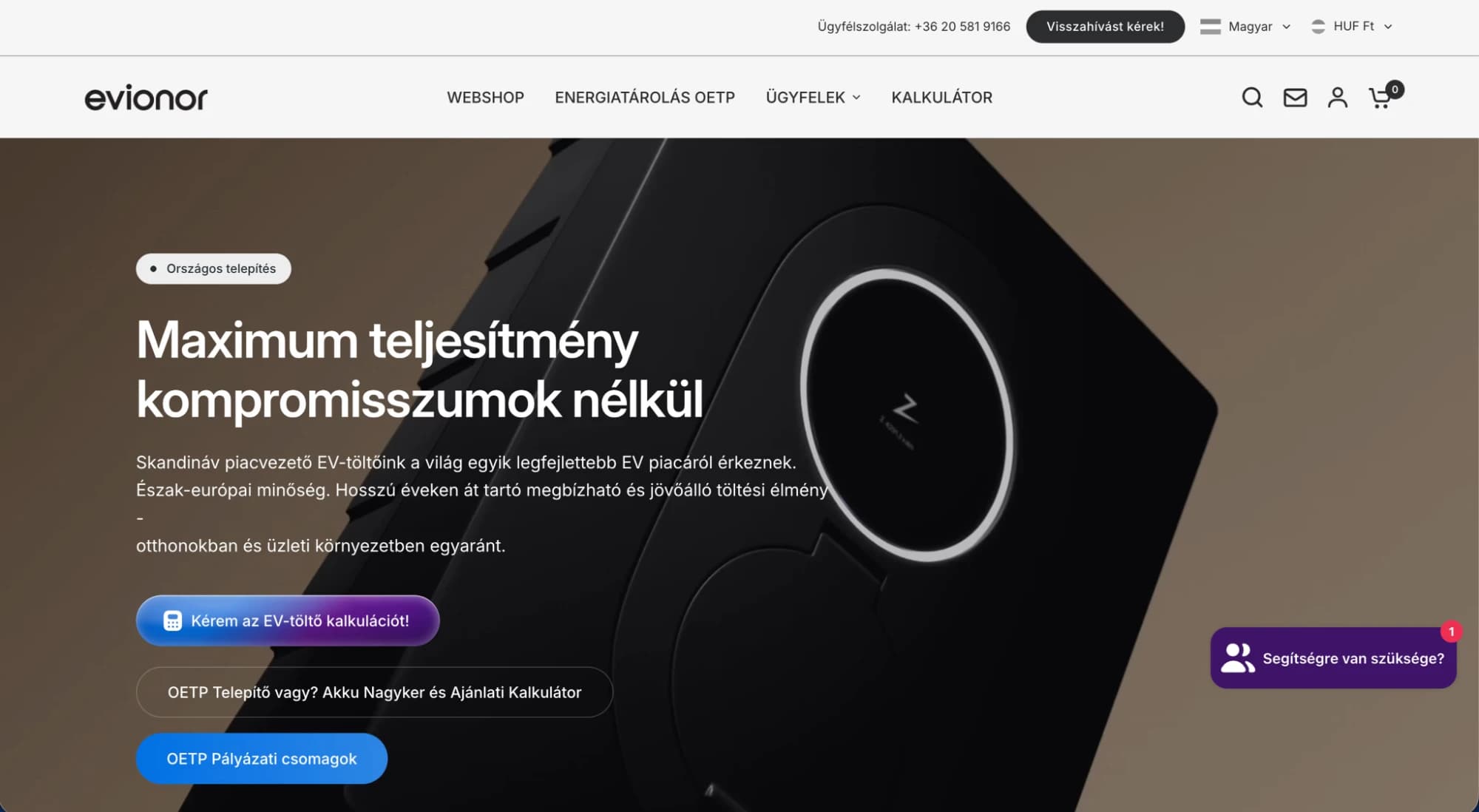
Overview
Evionor is the Hungarian distributor of Scandinavian premium EV chargers, entering a fast-growing market with no digital presence. They needed a Shopify e-commerce platform that could communicate technical credibility and premium quality while simultaneously handling B2C purchases (individual homeowners) and B2B fleet inquiries (corporate facility managers) — two audiences with very different decision-making processes and content needs.
Challenge
EV charging is a considered purchase with a long research phase. Before converting, homeowners need compatibility assurance, installation guidance, and price justification. Corporate buyers need fleet specs, service agreements, and procurement-friendly inquiry paths. A single Shopify store had to serve both without one audience feeling like an afterthought — or worse, accidentally routing the wrong audience down the wrong funnel.
Solution
I designed the full Shopify webshop in Figma with a product catalog architecture organized around purchase intent rather than product type. Each product page was built to serve the conversion journey of its primary buyer: home charger pages lead with compatibility (vehicle make/model), installation simplicity, and customer reviews; commercial pages lead with fleet specifications, certifications, and direct B2B inquiry CTAs. Educational landing pages — 'Which charger do I need?' and 'Installation guide' — serve as pre-conversion content that reduces the support burden and improves purchase confidence. The B2B inquiry flow is entirely separate from the retail checkout: a dedicated landing page, a streamlined form, and a professional follow-up path. I also set up Shopify's automated transactional email flows (order confirmation, shipping updates, abandoned cart) with on-brand templates matching the store's visual language.
Outcome
The webshop went live and generated its first orders within days of launch — a market entry from zero digital presence to operational Shopify store in six weeks. B2B inquiries came in through the dedicated flow from week one, keeping commercial and retail traffic cleanly separated.
Key Highlights
- Shopify store built from Figma designs with full theme customization
- Separate conversion flows for B2C purchase and B2B fleet inquiry
- Product pages designed around purchase intent, not product category
- Educational landing pages serving as pre-conversion content
- Abandoned cart and transactional email templates designed on-brand
- First orders within days of launch — market entry in 6 weeks
6 weeks
Launch time
B2C + B2B
Conversion flows
Within days
First orders
4
Email flows set up
Design Process
Audience Mapping
Mapped two distinct buyer journeys — homeowner and corporate buyer — with different research phases, decision criteria, and conversion actions.
Shopify Architecture
Structured the Shopify catalog, collections, and navigation to serve both audiences without overlap. Set up B2B inquiry flow as a separate landing page.
Product Page Design
Designed product pages around the primary buyer's conversion journey: compatibility first for B2C, specs and certifications first for B2B.
Educational Content
Designed pre-conversion landing pages ('Which charger?' and 'Installation guide') to reduce buyer uncertainty before reaching the product page.
Email & Automation
Designed on-brand transactional email templates and set up Shopify abandoned cart flows to recover high-intent drop-offs.