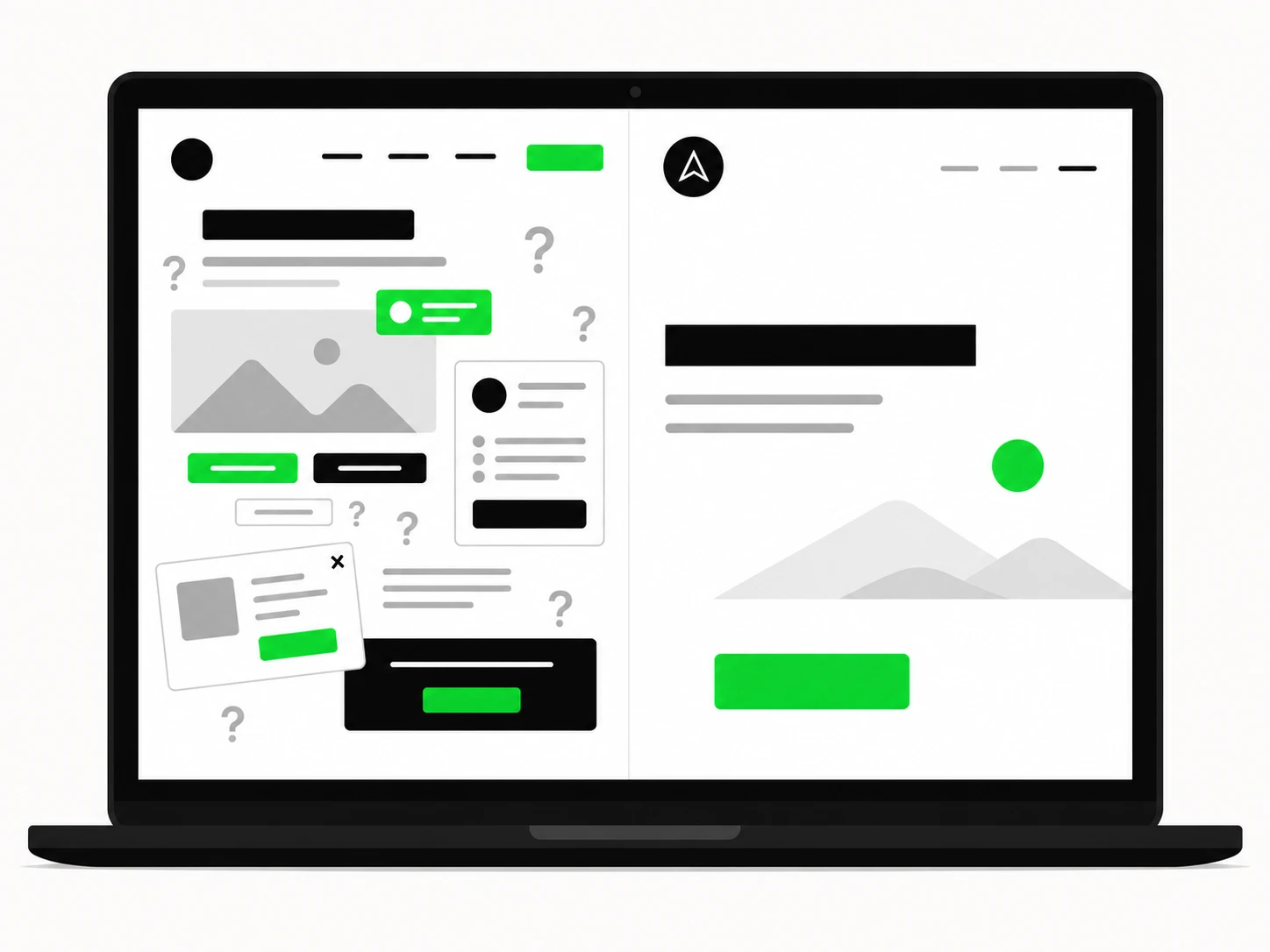
You've invested in the design. The copy is polished. The CTA button is above the fold, bright, and impossible to miss. And yet — the conversion rate is sitting at 1.2% and nobody knows why.
Most teams blame the wrong things. They A/B test button colors, tweak headlines, and rearrange sections — optimizing the surface while the real problem sits untouched underneath. This post is about how to actually diagnose a landing page that isn't converting.
The Real Reason Most Landing Pages Fail
It's not aesthetics. It's not even copy, most of the time. It's clarity.
When a user lands on your page, they're running a subconscious checklist in roughly three seconds: What is this? Is it for me? Do I trust it? What do I do next? If any of those questions go unanswered — or worse, trigger uncertainty — they leave. Not because the design is ugly. Because they're confused.
Confusion is the conversion killer nobody talks about.
The Four-Question Framework
Before you touch the design, run your landing page through these four questions as if you're a first-time visitor who's never heard of your product.
1. What is this, in one sentence?
Your headline should answer this completely. Not cleverly, not cryptically — completely. "AI-powered email marketing for e-commerce brands" is better than "Unlock your growth potential." The second headline says nothing. The first tells you exactly what you're looking at and whether it's relevant to you.
Test this by covering your logo and asking someone who has never seen your site to read the headline and describe the product. If they can't, the headline is failing.
2. Is it for me?
The fastest way to lose a qualified visitor is to write for everyone. "For teams of all sizes" is meaningless. "For Shopify stores doing $500K–$5M in revenue" immediately qualifies and attracts the right person. Specificity is not exclusion — it's trust-building. When a visitor sees themselves in your copy, they keep reading.
3. Do I trust this?
Trust signals are not just testimonials. They include: how professional the design looks, whether the copy sounds like a real person wrote it, load speed, mobile responsiveness, and whether social proof appears near the point of decision — not buried at the bottom. A glowing testimonial below the fold helps no one who left on the first scroll.
4. What do I do next?
One page, one primary action. If you have two CTAs competing for attention — "Start Free Trial" and "Book a Demo" — you've introduced a micro-decision that some percentage of users will resolve by doing neither. Pick the primary conversion action and make everything else secondary.
What to Audit First
If you're going into a landing page audit, start with these three areas before anything else:
Above the fold. Everything visible before the user scrolls must answer question one and two. If your hero section requires explanation, it's already failing.
The friction points. Where do users drop off? Use a heatmap tool — Hotjar, Microsoft Clarity (free), or similar — and look at scroll depth and click maps. The drop-off point tells you where the confusion lives.
The form. Every additional field in a form reduces completion rate. Ask only for what you genuinely need at this stage of the funnel. You can collect more information later.
The Redesign Trap
The instinct when a landing page underperforms is to redesign it. Resist this. A redesign is expensive, time-consuming, and often solves the wrong problem. Instead, run structured experiments: change one variable at a time, measure the impact, and iterate. A single headline change can move conversion rate more than a complete visual overhaul.
Design is a lever — but only when pulled in the right direction. Clarity first, aesthetics second.
If you're working on a landing page and want a second set of eyes on what's actually causing the drop-off, reach out — this is exactly the kind of problem I work on.